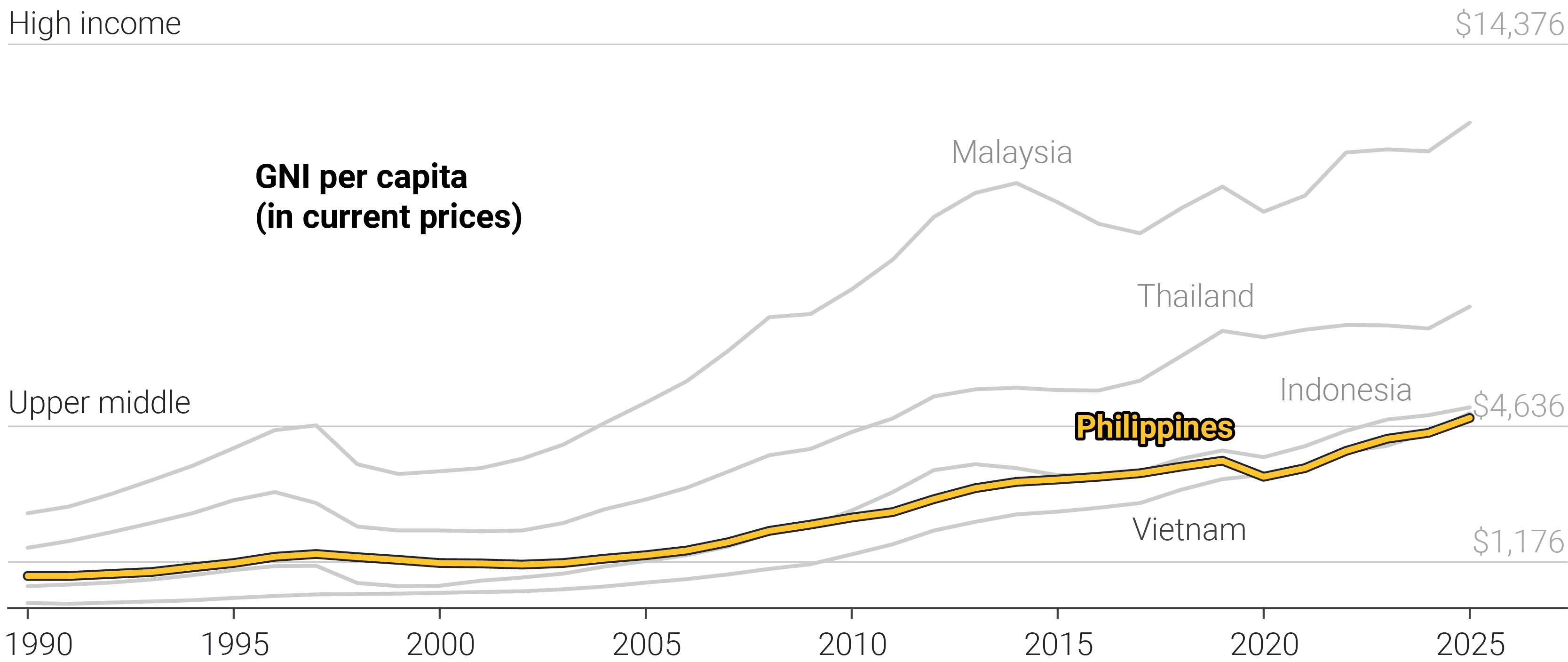
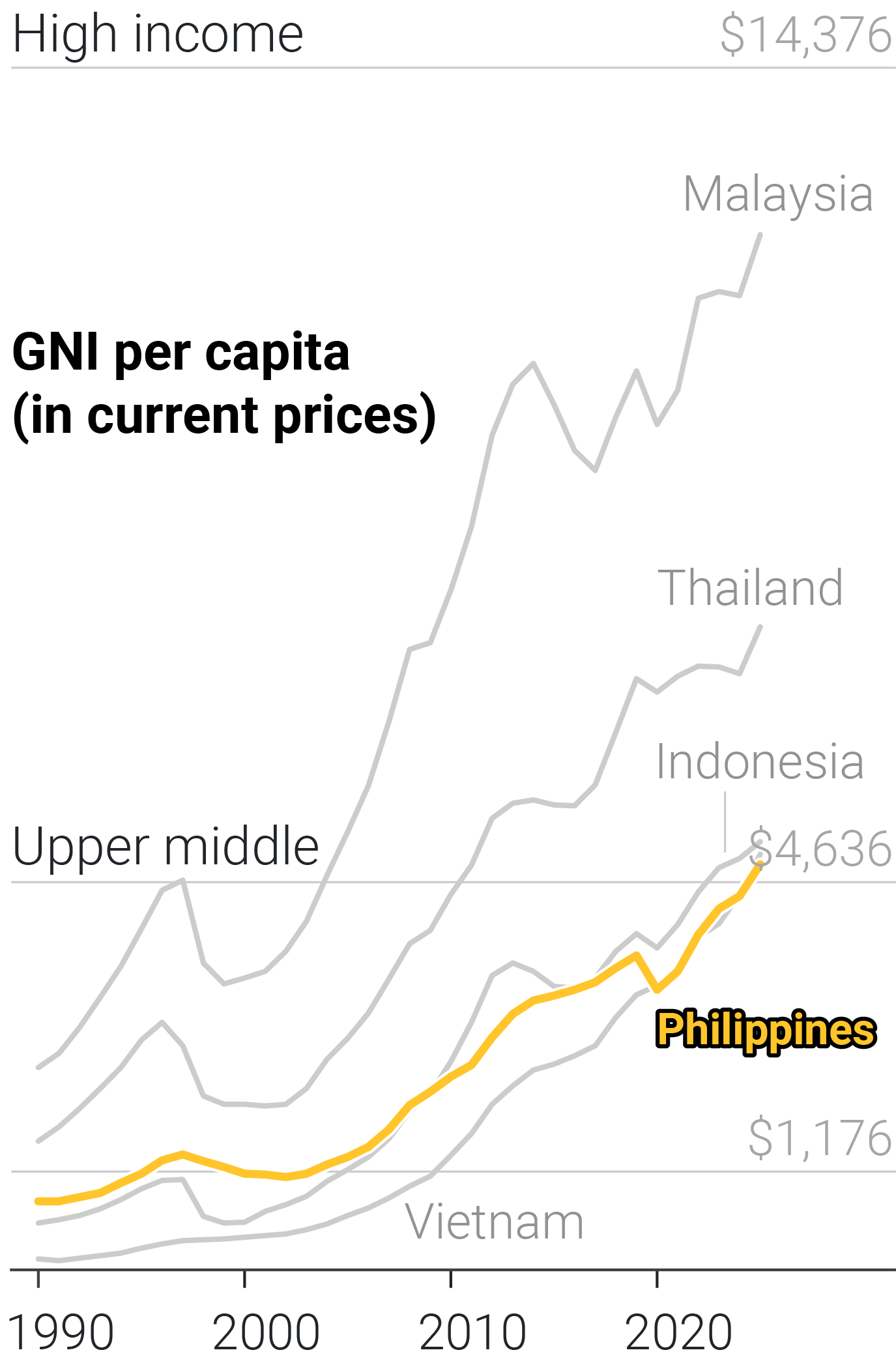
A line chart showing the GNI per capita of Asean-5 countries per year A line chart showing the GNI per capita of Asean-5 countries per year

We're an upper middle income economy.
So what?

Our new income classification is likely to be more a determinant of aid, not foreign investments.
July 14, 2026

The Philippines is now an upper middle income economy, according to the World Bank. So what?
Economic officials were quick to ride on the upgrade in recent weeks, hailing it both as a sign of progress and a signal to foreign investors to bet on the country's prospects. But critics said the achievement rang hollow as income disparities persist in a country where a fifth of the population are still considered poor.
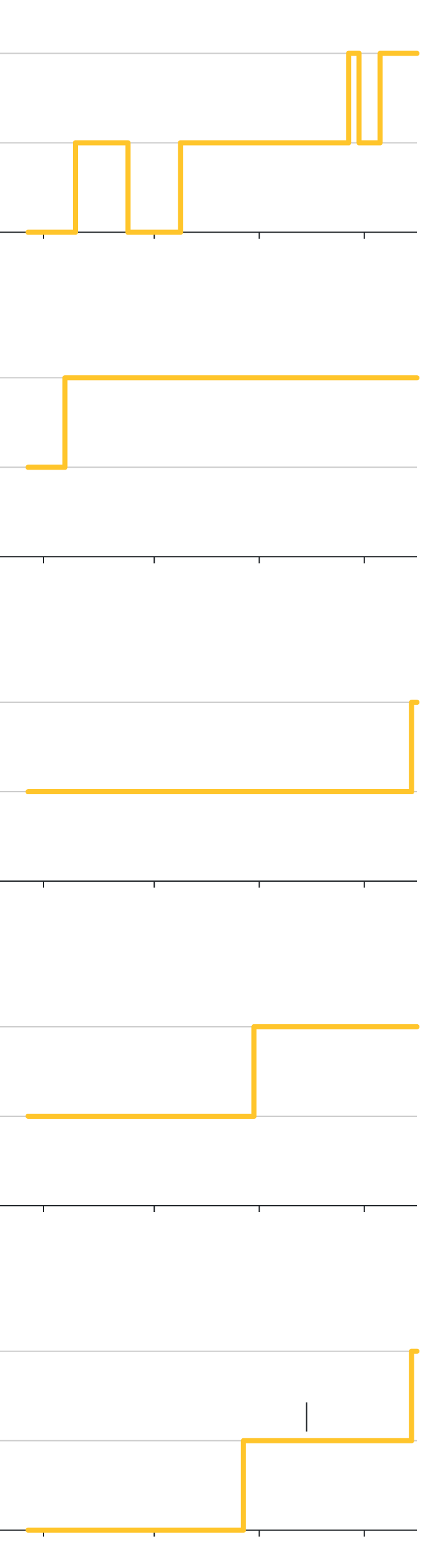
On paper, the upgrade does show the Philippines's growth trajectory in recent years. The country's income per capita, a broad measure of income per population, improved from $3,350 in 2016 to $4,850 this year, breaking the upper middle income benchmark of $4,636.

Income level may vary each year

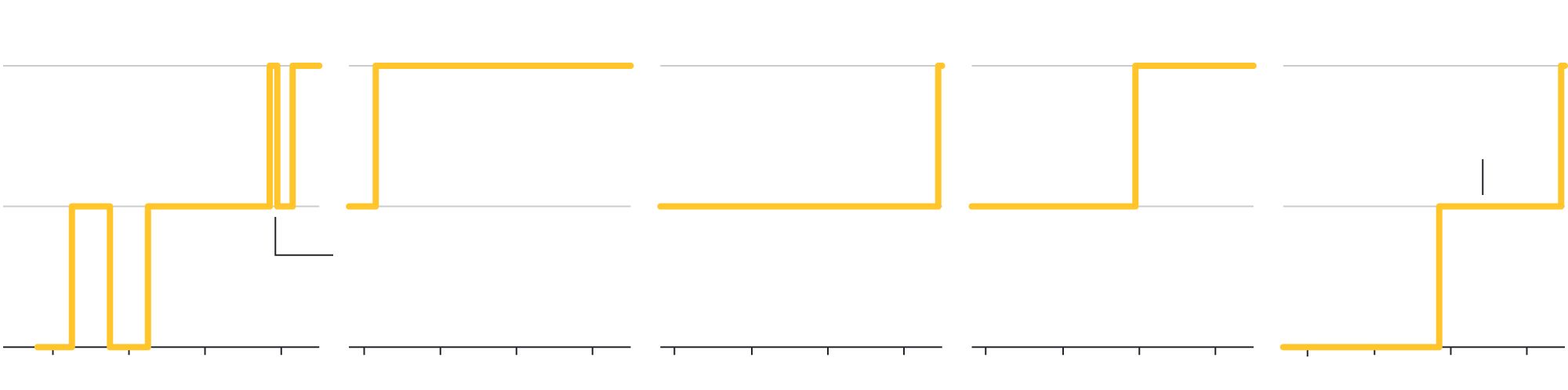
Income level of Asean-5 countries in the World Bank
Indonesia

Malaysia

Philippines

Thailand

Vietnam

Upper middle

Sustained upward trajectory for Vietnam.

Lower

middle

Indonesia fell back to lower middle income in 2020 due to the pandemic.

Low

1990

2000

2010

2020

1990

2000

2010

2020

1990

2000

2010

2020

1990

2000

2010

2020

1990

2000

2010

2020
Indonesia

Upper middle

Lower middle

Indonesia fell back to lower middle income in 2020 due to the pandemic.

Low

1990

2000

2010

2020

Malaysia

Upper middle

Lower middle

Low

1990

2000

2010

2020

Philippines

Upper middle

Lower middle

Low

1990

2000

2010

2020

Thailand

Upper middle

Lower middle

Low

1990

2000

2010

2020

Vietnam

Upper middle

Sustained upward trajectory for Vietnam.

Lower middle

Low

1990

2000

2010

2020

The move also puts the Philippines, and Vietnam which was also upgraded, in the same group as their Southeast Asian neighbors like Thailand and Indonesia. But beyond that, the upgrade hardly signals prosperity whether now or in the future, as what the data suggests.
Income categories are just that, categories. Similar to putting countries into buckets like geographical locations, income classifications are meant to lump countries together under a single column for measurement purposes. In the World Bank's case however, income levels also serve as a metric considered when the multilateral agency extends financial aid.
Formed after the world war, the World Bank has two official lending entities namely the International Development Assistance (IDA) and the International Bank for Reconstruction and Development (IBRD). In simplest terms, IDA hands out aid to low and lower middle income countries, while IBRD does so for upper middle income nations.
IDA is also the only World Bank arm that gives out grants, which is not subject to repayment. IBRD only provides loans and guarantees, among others.
These differences are important for the World Bank and the countries borrowing from it. IDA typically hands out grants and loans at "concessional rates," a financial term that essentially means borrowers are charged zero interest from borrowing. IBRD, meanwhile, charges at market rates.

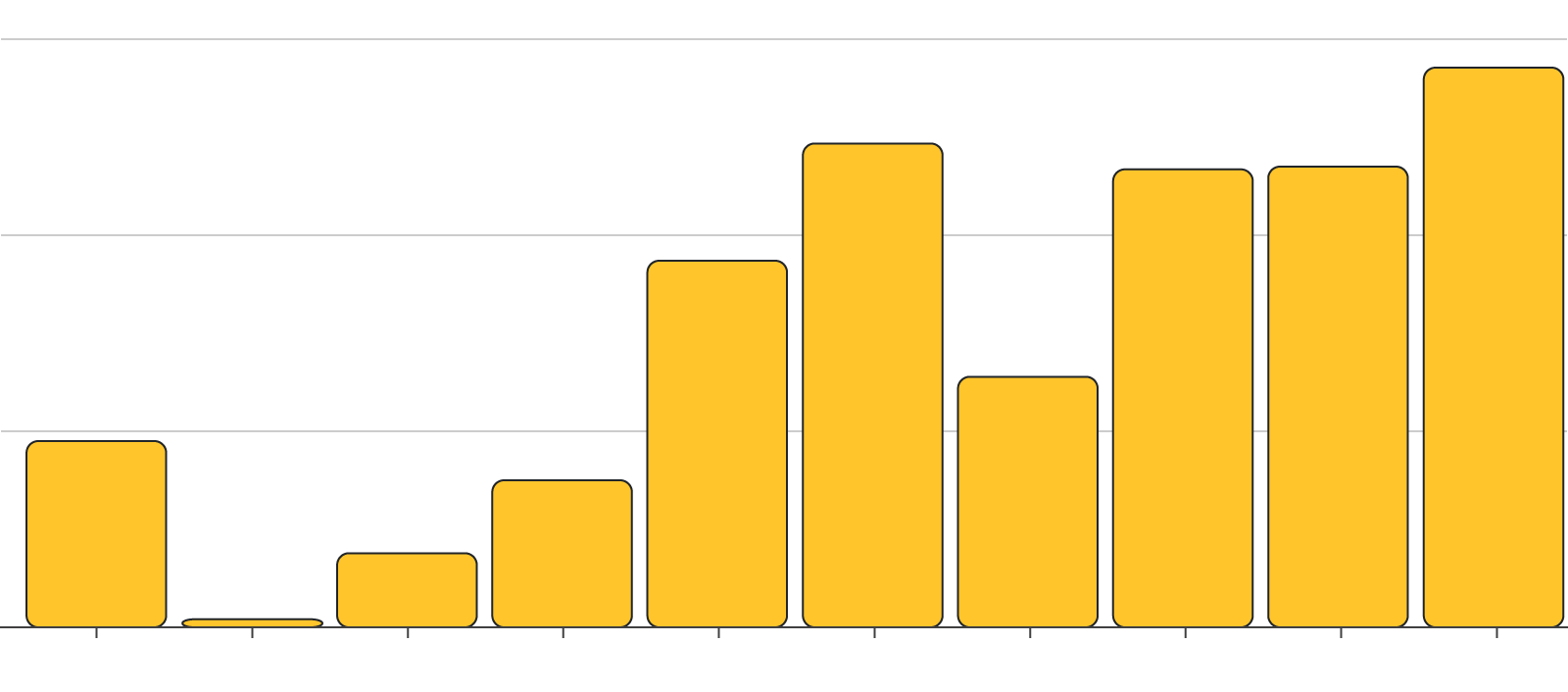
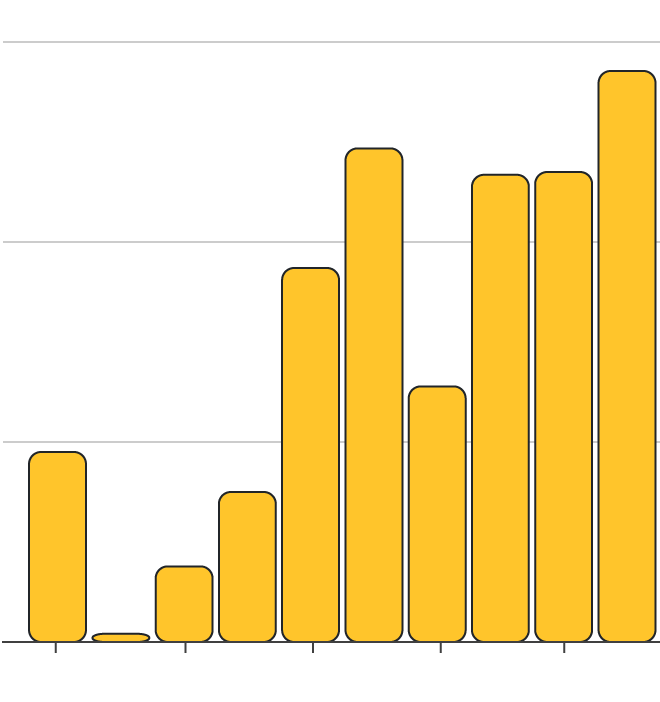
World Bank funding to the Philippines has risen since 2020

Funding disbursements, exclusive of repayments
$3 billion

2

1

2016

2017

2018

2019

2020

2021

2022

2023

2024

2025
$3 billion

2

1

2016

2018

2020

2022

2024

Since 1994, the Philippines has been borrowing from the World Bank through the IBRD. While IBRD lends to all countries, except low income nations, not every borrower is treated the same.

The IBRD is operated by 189 member countries of the World Bank, which contributes to its funding. These countries are both donors and recipients of the IBRD.

The institution lends to three types of economies namely the upper middle income, high income and “blended” economies. “Blended economies” are those transitioning from IDA to IBRD, and get funding from both institutions while doing so.

From there, countries are further categorized into four groups, depending on how far they are from an income threshold set by the World Bank. This threshold is separate from the published income classifications and is used to set interest rates in loans.

The Philippines, for instance, falls under Group B, while Malaysia falls under Group C.

Indeed, while Malaysia and the Philippines are now both upper middle income economies, Malaysia is charged a higher interest rate by the World Bank in some long term loans. Another example is Vietnam: the country is charged a lower rate than the Philippines despite the two advancing nearly in lockstep in per capita income.

Countries are charged different loan rates

IBRD flexible dollar loan rates

Up to 8 years

8 to 10 years

10 to 12 years

Malaysia

0.95%

1.05%

1.25%

Indonesia

0.95%

1.05%

1.20%

Philippines

0.95%

1.05%

1.20%

Thailand

0.95%

1.05%

1.20%

Vietnam

0.75%

0.95%

1.05%

Interest rates vary on long term loans

Up to 8

years

8 to 10

10 to 12

Malaysia

0.95%

1.05%

1.25%

Indonesia

0.95%

1.05%

1.20%

Philippines

0.95%

1.05%

1.20%

Thailand

0.95%

1.05%

1.20%

Vietnam

0.75%

0.95%

1.05%

Interest rates vary on long term loans

Note: Figures are charged on top of the secured overnight financing rate.

In reality, lending rules within the World Bank are not solely determined by a country's income level. Other factors such as "creditworthiness" or the capacity of a country to service its debts often come into play.
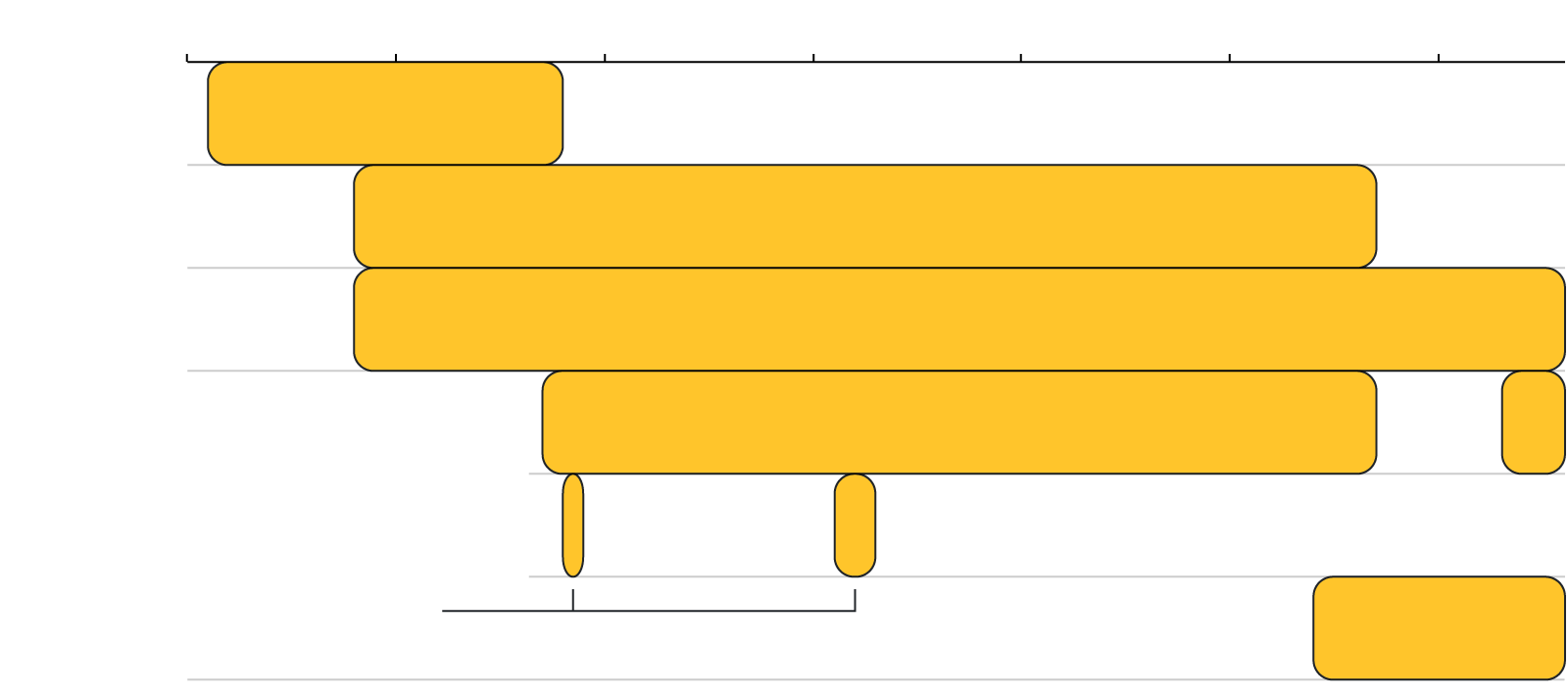
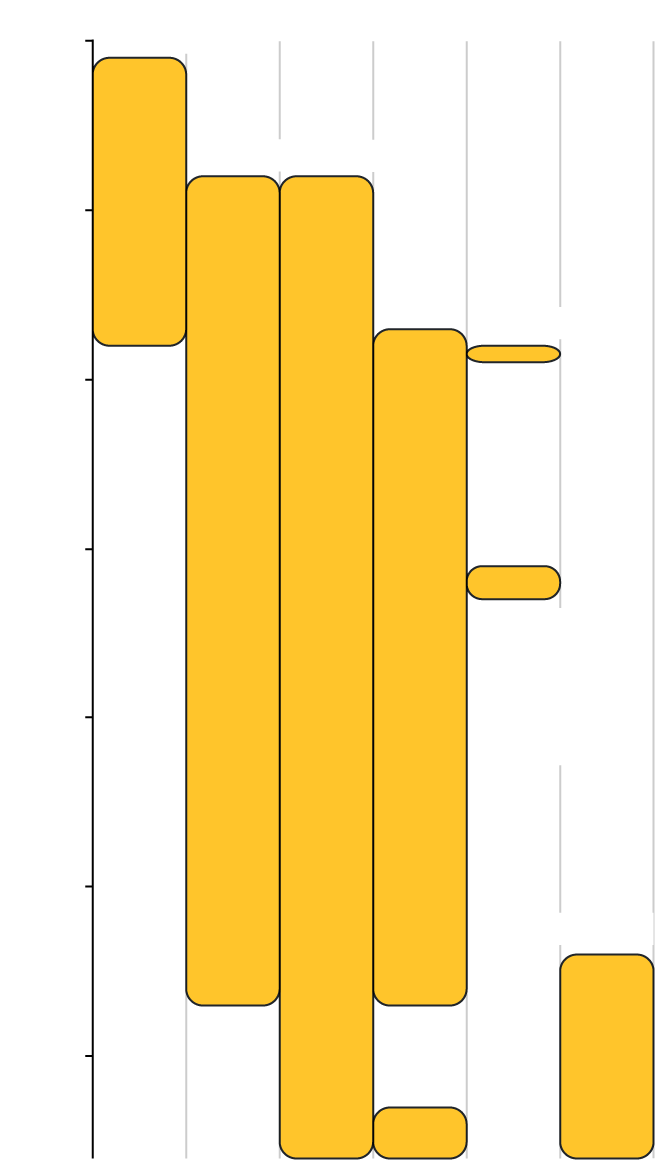
In fact, despite being qualified on paper prior to the upgrade, the Philippines has not received funding from the IDA, which gives out both loans and grants to lower income countries, since 1993. Now an upper middle income economy, Economic Planning Secretary Arsenio Balisacan had said the Philippines has three years to fully transition out of the World Bank's lower lending rates. This essentially means that the Philippines will have to pay higher interest on its loans from the agency.

Philippines has long exited World Bank's low income funding facility

Periods by which recently income upgraded countries by the World Bank first and last received IDA funding
1960

1970

1980

1990

2000

2010

2020

Jordan

Vietnam

Togo

Sri Lanka

The Philippines first graduated from IDA in 1979. It went back to it in 1991 and graduated again in 1993.

Philippines

Micronesia
Jordan

1960

Togo

Vietnam

1970

Sri

Lanka

Philippines

1980

1990

Last IDA funds received in 1993.

2000

2010

Micronesia

2020

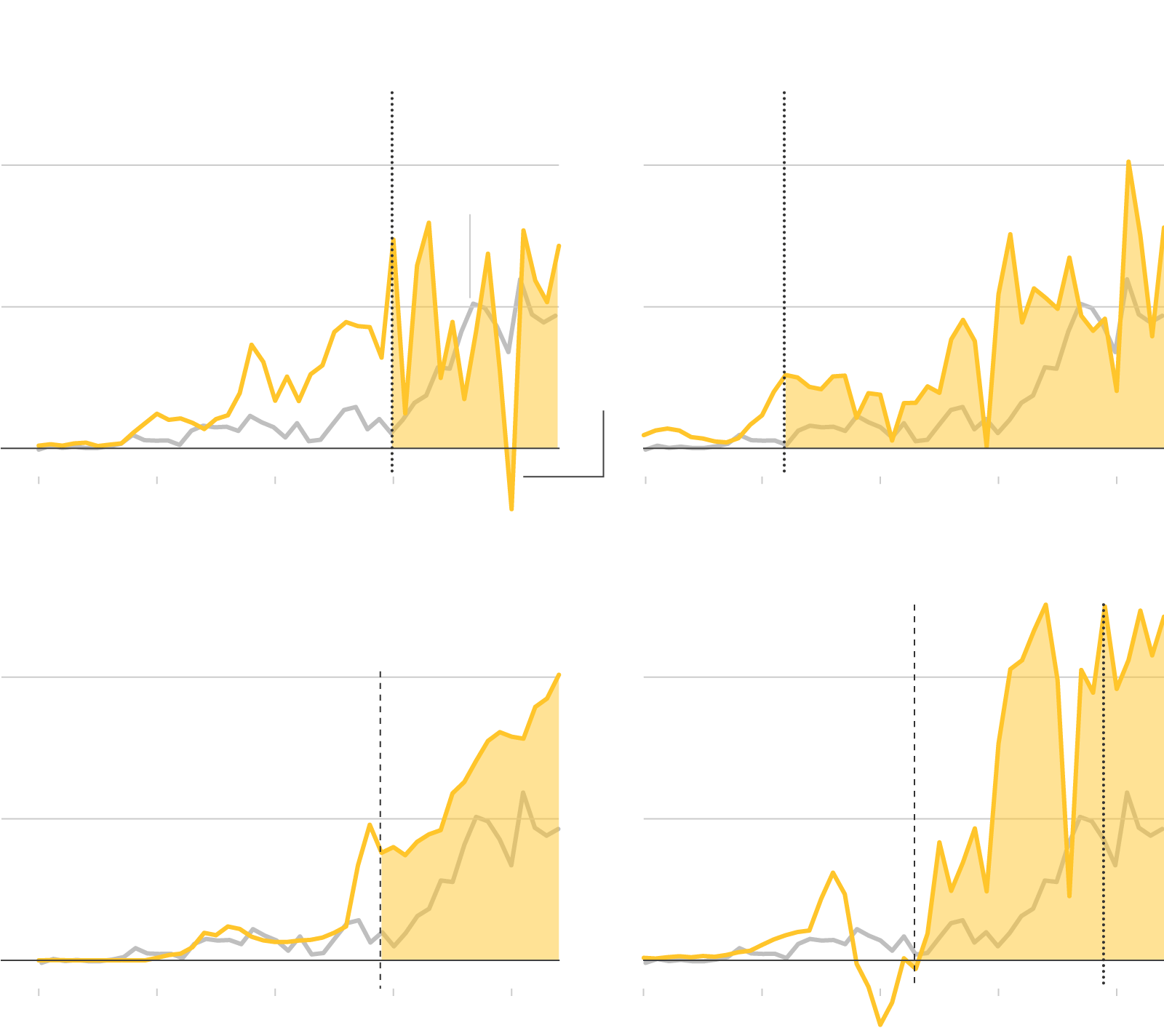
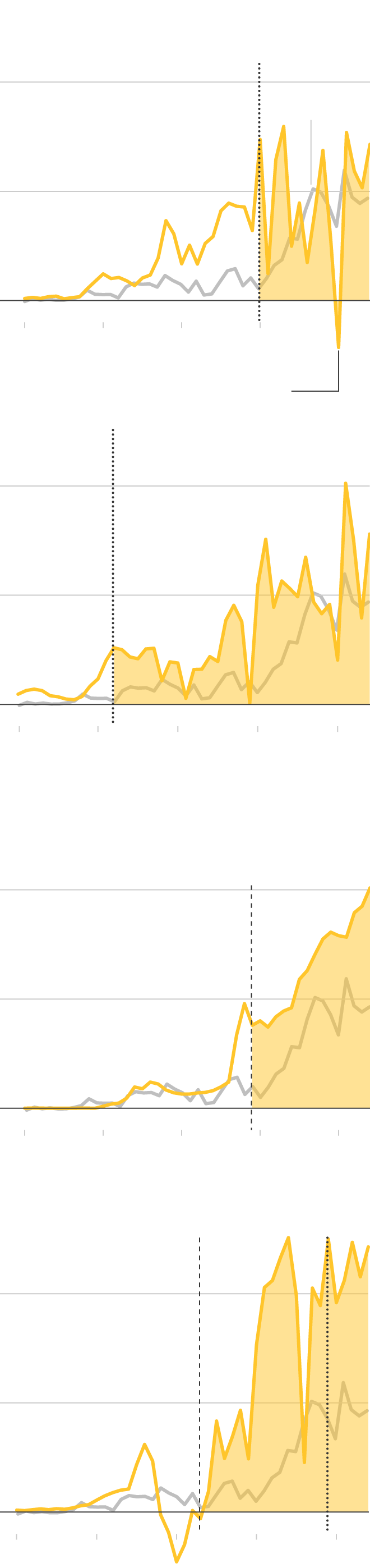
Outside the World Bank, income classifications have had little bearing. Balisacan, in a statement, said the upgrade could drive more foreign investments to the Philippines. But data show that in other Southeast Asian countries, an improvement in income level is hardly a determinant of foreign direct investments.

Higher income level is not equal to more investments

Net flows of foreign direct investments
Becomes upper-middle income

Thailand

Malaysia

$20 billion

Philippines

$10 billion

More FDI exited than entered

1980

1990

2000

2010

2020

1980

1990

2000

2010

2020
Vietnam

Indonesia

Becomes low-middle income

$20 billion

$10 billion

1980

1990

2000

2010

2020

1980

1990

2000

2010

2020

Becomes upper-middle income

Thailand

$20 billion

Philippines

$10 billion

1980

1990

2000

2010

2020

More FDI exited than entered

Malaysia

$20 billion

$10 billion

1980

1990

2000

2010

2020

Vietnam

Becomes low-middle income

$20 billion

$10 billion

1980

1990

2000

2010

2020

Indonesia

$20 billion

$10 billion

1980

1990

2000

2010

2020


Source

World Bank

Copyright 2026 - The Data Dictionary Project